Toronto homeowners with garages, basement gyms, or finished workshops face a familiar choice: should the floor be epoxy or tile? Both surfaces look sharp, both promise durability, and both come with strong claims from local contractors.
This guide compares epoxy flooring vs tiles in Toronto for garages and basements, with real costs, lifespan numbers, and use-case advice. The work comes straight from professional epoxy flooring in Toronto installers. The team at GLI Epoxy Flooring has installed both finishes across the GTA since 2019.
How Toronto Conditions Stress Floor Materials
Toronto winters cycle hard between thaw and deep freeze. Garages take road salt, ice melt, snow drag, and brine from city streets every winter. Floors below grade in older homes near High Park, Riverdale, and the Annex deal with steady basement humidity year round.
Detached garage slabs flex with frost heave. Basement slabs sit on subgrade that can shift slightly with moisture levels. Any floor material installed on top has to handle this movement without cracking or popping loose.
Indoor air quality also matters. Health Canada flags wet basements as a driver of mould growth and respiratory issues. Moisture control is the first line of defence for any finished lower level in Toronto.
Epoxy Flooring in Toronto Garages and Basements
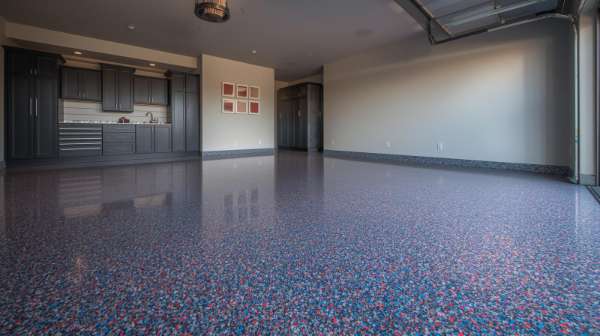
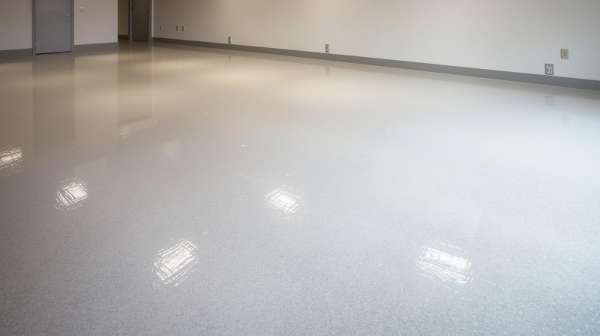
Epoxy flooring is a two-part resin coating applied directly over a prepared concrete slab. The system bonds chemically with concrete and forms a continuous, non-porous surface roughly 30 to 60 mils thick depending on the build-up.
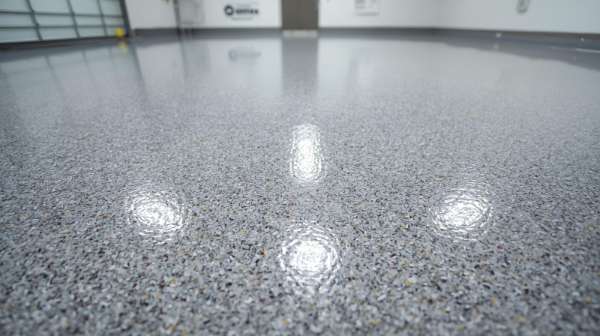
Quality installs start with shot blasting or diamond grinding to open the concrete pores. Without that prep, epoxy can peel within months. GLI Epoxy Flooring runs a multi-coat system that includes a moisture-tolerant primer, a base coat, decorative flake, and a UV-stable polyaspartic topcoat.
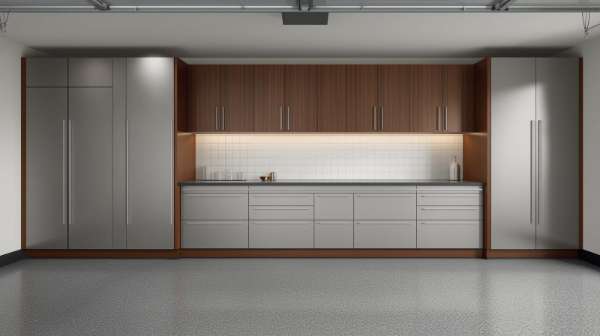
For Toronto garages, the result resists salt, oil, brake fluid, road grime, and tire pickup. For basements, it seals the slab against vapour rise and creates an easy-clean surface ideal for home gyms, workshops, and laundry rooms. Most jobs finish in 1 to 2 days. Browse real installs through epoxy garage floor installation projects across the GTA.
Tile Flooring in Toronto Garages and Basements
Tile flooring for garages typically means heavy porcelain or thick ceramic rated for high impact loads. Basements lean more toward standard porcelain, luxury vinyl tile, or interlocking modular tiles set over a moisture barrier.
Tiles install over a levelled substrate using thinset mortar and grout. The installation runs slower than epoxy, often 3 to 5 days for a two-car garage including cure time. Tiles cannot bond directly to a rough slab the way epoxy can.
The grout lines are the weak point. In Toronto basements, grout absorbs moisture and breeds mould without rigorous sealing. In garages, road salt soaks into grout and freezes, lifting tiles within 2 to 3 winters on unsealed installs.
Direct Comparison Across the Five Things That Matter
The table below puts both finishes side by side on the criteria GLI Epoxy Flooring clients ask about most often.
| Criterion | Epoxy Flooring | Tile Flooring |
|---|---|---|
| Cost installed (Toronto, 2026) | $7 to $14 per sqft | $9 to $20 per sqft |
| Typical lifespan | 10 to 20 years | 15 to 25 years with grout upkeep |
| Installation time | 1 to 2 days | 3 to 5 days |
| Moisture resistance | Fully sealed, no grout lines | Tiles fine, grout vulnerable |
| Slip resistance | Customisable with flake or grit | Depends on tile finish |
Costs reflect typical Toronto labour rates for prepped concrete slabs in average condition. Heavily damaged slabs in older Cabbagetown or Leslieville homes can add $2 to $4 per square foot in prep work for either system.
Cost Breakdown for Toronto in 2026
A typical two-car garage in Etobicoke or Scarborough runs roughly 400 to 500 square feet. An epoxy system at $9 per square foot lands around $3,600 to $4,500 installed. A premium tile install at $15 per square foot runs $6,000 to $7,500.
For a 600 square foot basement floor, expect $4,200 to $8,400 for epoxy versus $5,400 to $12,000 for tile. Tile costs jump with intricate patterns, large-format slabs, and high-end porcelain choices from premium suppliers.
Long-term cost favours epoxy in moisture-prone spaces. Grout repairs in basements run $300 to $600 per service call when mould treatment is needed. Epoxy needs a topcoat refresh roughly every 7 to 10 years at $2 to $4 per square foot.
Weighing epoxy or tile for a Toronto garage, basement, or workshop? Call 416-899-2141 for a free on-site quote, slab assessment, and finish samples across Toronto, Mississauga, Vaughan, and the GTA. Contact the team online for a fast turnaround.
When Tiles Beat Epoxy and When They Do Not
Tile remains the right call for bathrooms, kitchens, mudrooms, and entryways where standing water sits regularly. Porcelain tile handles full humidity all day with the right grout and waterproof membrane underneath.
Tiles also win on aesthetic patterning. Large-format slabs, hexagons, and decorative inlays simply do not have a true epoxy equivalent. Designers working on high-end Forest Hill renovations often spec tile for visible living areas.
For garages, basement gyms, workshops, laundry rooms, and storage areas, epoxy wins on durability, speed, and cost. Tiles cannot easily handle car weight, salt brine, or impact loads from dropped tools.
Best Choice by Toronto Use Case
Detached garages and laneway garages across East York, Mimico, and North York call for epoxy. The combination of road salt, vehicle weight, and temperature swing is rough on grout systems and rigid porcelain tile.
Basement workouts, home gyms, and Peloton corners benefit from epoxy’s continuous finish and easy cleanup. Sweat, water bottle spills, and rubber tile residue wipe clean from a sealed surface within seconds.
Commercial spaces follow similar logic. Warehouse coatings, retail floors, and showroom builds in industrial parks near Vaughan and Concord usually run epoxy or polyaspartic systems. See examples through commercial warehouse system coatings projects in the GTA.
Resale and Property Value Impact in Toronto
A finished garage or basement with a quality floor lifts perceived property value in Toronto’s housing market. Realtors across the GTA report that buyers walk through unfinished basements quickly, and an epoxy or premium tile floor signals a finished, usable space ready from day one.
Epoxy garage floors add roughly $2,500 to $5,000 in perceived value on a typical detached home in Etobicoke, North York, or Scarborough. Basement epoxy finishes that turn a damp slab into a gym, office, or playroom often return 60 to 80 percent of the install cost at resale. Tile installs in living areas can match this return when the finish quality is high and the pattern reads as designer rather than dated.
The bigger boost comes from a space that looks complete, dry, and easy to clean. Toronto buyers in 2026 lean toward low-maintenance finishes that signal years of use ahead without immediate renovation work needed.
Common Toronto Installation Mistakes to Avoid
Skipping the moisture vapour test is the single biggest cause of epoxy failure in Toronto basements. Older homes near the Don Valley and along the lakeshore push 3 to 6 pounds of moisture per 1,000 square feet per 24 hours. Standard epoxies fail above 3 pounds, and trapped moisture also raises the mould risk flagged by Health Canada mould and moisture guidance.
Cutting corners on prep also kills tile installs. Tiles set on unlevelled slabs crack within months. Always confirm the contractor budgets for self-levelling underlayment in older Toronto homes.
Skipping a topcoat sealer on either floor shortens lifespan by 30 to 50 percent. Toronto road salt and basement humidity will find the weakest layer first.
Final Verdict for Toronto Homeowners
For garages, basements, and workshops in Toronto, epoxy flooring wins on cost, speed, durability, and moisture resistance. Tile holds the edge in bathrooms, kitchens, and high-design living areas where standing water and aesthetics drive the choice. Most GTA homeowners get the best result by matching the finish to the room rather than picking one floor for the whole property.
A trained installer makes the difference between a 20-year floor and a 2-year failure. GLI Epoxy Flooring runs full slab prep, moisture testing, and a multi-coat system designed for Toronto conditions. Homeowners can browse the completed Toronto project gallery before booking a quote.
For a free on-site assessment, finish samples, and a transparent quote across Toronto, Mississauga, Vaughan, Markham, and the GTA, call GLI Epoxy Flooring at 416-899-2141 or reach the team online. The company has run epoxy and prep work across the region since 2019 under fully licensed, insured operations.
Frequently Asked Questions
Is epoxy flooring better than tile for a Toronto garage?
For most Toronto garages, epoxy flooring is the stronger choice. The continuous surface resists road salt, brine, and vehicle weight without the cracking and grout failures that tiles develop within a few winters. Epoxy also installs faster, costs less per square foot, and handles freeze-thaw cycles better than rigid porcelain. Tile only outperforms epoxy in garages used as showroom or display spaces with light vehicle use.
How long does epoxy flooring last in a Toronto basement?
A properly installed epoxy basement floor lasts 15 to 20 years in Toronto conditions. The keys are correct slab prep, a moisture-tolerant primer, and a UV-stable polyaspartic or polyurethane topcoat. A topcoat refresh every 7 to 10 years extends lifespan further. Skipping moisture testing in older Toronto homes is the most common reason basement epoxy fails early.
Can tiles be installed on a Toronto garage slab?
Yes, but only with full prep. The slab must be level, crack-free, and dry, and the tile must be rated for vehicle traffic. Porcelain rated above 8 mm thick and a high-strength thinset mortar give the best results. Most Toronto installers also seal all grout lines with a penetrating sealer rated for freeze-thaw exposure. Even with care, salt and brine shorten tile lifespan in garages compared with epoxy.
What is the average cost of epoxy vs tile in Toronto?
In 2026, professional epoxy floor installation in Toronto runs $7 to $14 per square foot, including slab prep and a multi-coat finish. Porcelain tile installs cost $9 to $20 per square foot, including mortar, grout, and labour. Pricing varies with slab condition, home access, and finish complexity. Older homes in neighbourhoods like Cabbagetown or Riverdale often need extra prep, which adds $2 to $4 per square foot to either system.
Will epoxy flooring crack on a Toronto basement slab?
Quality epoxy systems flex enough to handle minor slab movement without cracking. Hairline movement from seasonal humidity is normal in Toronto basements and rarely affects a properly installed epoxy floor. Large structural cracks need repair before the coating goes on. Skipping crack repair leads to telegraphing cracks through the finish within the first year.
How long does an epoxy installation take vs a tile install?
A typical Toronto garage epoxy install runs 1 to 2 days from prep to final cure. Polyaspartic topcoats cut that to a single day on smaller jobs. A comparable tile install takes 3 to 5 days, including thinset cure, grout cure, and sealing. Basement projects follow similar timelines. Epoxy lets homeowners use the space sooner with less disruption.
Does epoxy flooring work over heated floor systems in Toronto basements?
Yes, epoxy installs over hydronic and electric heated floor systems in Toronto basements when the heating loop is correctly embedded in the slab. The slab must run at a stable temperature during cure, typically 18 to 24 degrees Celsius, so installers schedule the heating system to stay on a steady setting through the curing window. Polyaspartic topcoats handle the cyclic warming and cooling of a heated slab better than older epoxy chemistries. Tile also works well over heated floors but takes longer to install and grout.