Toronto homeowners deal with basement conditions no other Canadian city quite matches. Spring water tables, freeze-thaw cycles, and slabs poured before vapour barriers were code all sit under the same square foot. Epoxy basement flooring Toronto homeowners trust has to handle every one of those pressures, not just look good in a showroom.
This 2026 guide covers the systems, costs, prep work, and neighbourhood realities that separate floors lasting two years from floors lasting twenty. Most calls come from homeowners considering residential epoxy flooring for the first time, and at GLI Epoxy Flooring the answers come from finished basements across the GTA.
Why Toronto Basements Need a Different Flooring Approach
Toronto basements sit in a climate that punishes flooring. Outside temperatures swing from minus 20 in February to plus 30 in August. Basement slabs hold their own thermal lag underneath that range.
Spring runoff raises water tables across the city, pushing moisture up through concrete pores from below. The other issue is age. A large share of homes inside the old City of Toronto boundary went up before 1970. Many were poured without modern under-slab vapour barriers.
Even newer GTA builds sit on slabs that develop hairline cracks during the first two winters. Any flooring system bonded to that concrete has to handle three forces at once. Vapour drive, alkalinity, and slab movement all act on the floor every season. The carpet absorbs moisture and grows mould inside for two summers.
Laminate warps along seams as humidity climbs. Vinyl plank cups at the joints when basement RH crosses 70 percent. A properly installed epoxy system bonds chemically to the slab, stays vapour-permeable in the right formulation, and outlasts every soft-surface alternative when prep is done correctly.
How to Tell If a Basement Is Ready for Epoxy
Not every basement slab is a candidate on day one. The wrong floor in the wrong basement fails inside eighteen months. The most common reason is skipped prep, not bad product. GLI Epoxy Flooring runs three checks on every Toronto basement before quoting any epoxy system.
Moisture testing the slab
Two tests matter. A calcium chloride test measures how much moisture leaves the slab over 24 hours. Results come in pounds per 1,000 square feet. Anything above 3 lbs and most epoxy primers will fail.
A relative humidity probe measures in-depth moisture inside the slab. Readings above 80 percent call for a moisture mitigation primer. Some basements need a different system entirely. Skipping this step is how peeling floors happen.
Cracks, spalling, and existing coatings
Hairline cracks under 1.5 mm get chased open and filled with a polyurea or rapid-set epoxy crack filler. Wider cracks signal slab movement and need structural review, not cosmetic patching. Old paint, sealers, or DIY epoxy kits all have to come up through mechanical professional surface prep before anything new goes down. Diamond grinding to a CSP 3 profile is the Toronto standard for basement installs.
Epoxy, Polyaspartic, or Polyurethane: Which System Belongs in a Basement
The word “epoxy” gets used loosely. Three different chemistries dominate the basement market. Each one behaves differently in a Toronto subgrade environment.
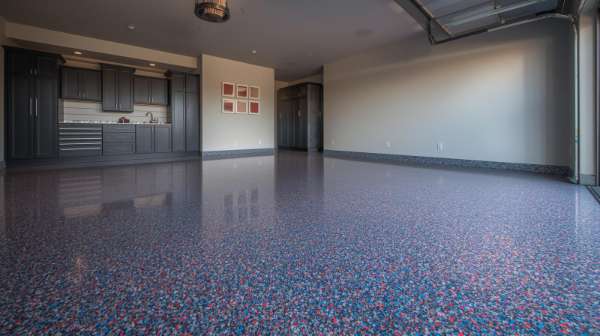
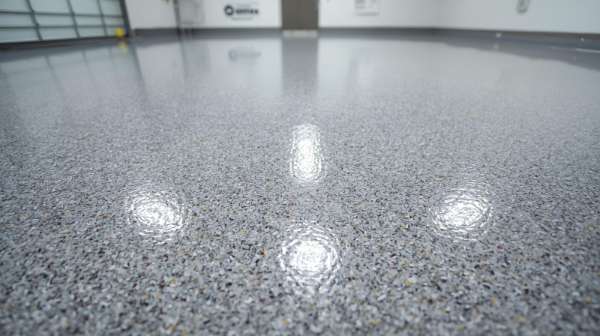
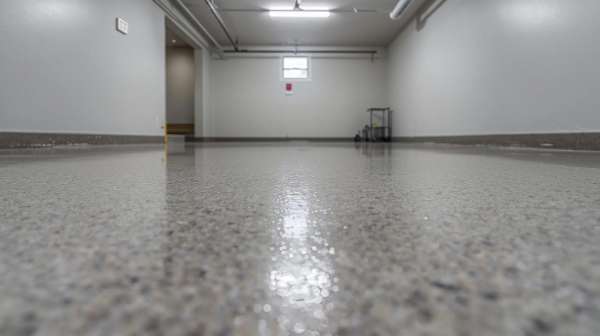
Standard solid epoxy is a two-part resin that cures hard, chemical-resistant, and visually rich. It is the right pick for most finished basements that stay below 80 percent RH. It pairs well with epoxy with flakes or a metallic epoxy flooring finish for showpiece spaces. Polyaspartic coatings cure faster, stay UV-stable, and tolerate lower temperatures during install.
Strong basement systems stack four layers. A moisture-mitigating primer, a pigmented base, decorative media, and a polyurethane or polyaspartic topcoat. Standard epoxy works best in finished, climate-controlled basements used for rec rooms or home gyms. Polyaspartic shines in basements that double as workshops or storage, where fast re-occupancy and salt resistance matter. Hybrid stacks deliver the longest service life in mixed-use basements that see kids, dogs, gym weights, and the occasional wet boot in the same week.
System choice also affects timeline. Standard epoxy installs run 3 to 4 days from grind to walk-on. Polyaspartic systems compress that to 1 or 2 days because of the faster cure profile. Homeowners under a renovation deadline often pay the polyaspartic premium for the schedule alone. The trade-off is cost, since polyaspartic resin runs 30 to 50 percent higher per gallon than standard epoxy. A reputable installer walks every homeowner through the system trade-offs before locking the quote.
2026 Cost Guide: Epoxy Basement Flooring in Toronto
Pricing varies more in basements than in garages. Slab condition, moisture readings, and access through narrow stairwells all move the number. The table below reflects what GLI Epoxy Flooring quotes across the GTA in early 2026 for a basement between 600 and 1,200 square feet.
| Finish | Typical Cost (CAD/sq ft, 2026) | Best For |
|---|---|---|
| Solid colour epoxy | $7 – $11 | Storage areas, workshops, utility basements |
| Flake epoxy (full broadcast) | $9 – $14 | Family rooms, gyms, kids’ play areas |
| Metallic epoxy | $12 – $18 | Showpiece finished basements, entertainment spaces |
| Quartz or full-system polyaspartic | $14 – $22 | Wet bars, salt-exposed entries, premium builds |
Costs climb in three scenarios. Moisture mitigation primer adds $1.50 to $3 per sq ft. Crack repair on more than 5 percent of the surface adds labour. Removal of existing flooring adds disposal fees.
Below 500 square feet, expect a minimum project fee around $3,500. That covers crew mobilisation, grinding rental, and material minimums. For tailored numbers, contact us for pricing with the slab size, current finish, and any known leaks.
Step-by-Step: How a Toronto Basement Epoxy Floor Gets Installed
Most professional Toronto basement epoxy installs take two to four days from grind to walk-on. Living above is fine on every day except install day. Pets and kids should stay out for the first 24 hours after coating goes down.
Day 1: Moisture test and prep
The crew runs RH probes, masks walls and stairs, and removes any prior coating or adhesive. Then comes concrete diamond grinding to a CSP 3 profile. Vacuum dust extraction and crack repair follow.
Day 2: Primer and base coat
A moisture-mitigating primer goes down where readings call for it. Once cured, the pigmented epoxy or polyaspartic base coat rolls on at the spec’d mil thickness. Flakes broadcast into the wet base, full reject, for full-coverage finishes.
Day 3: Scrape, vacuum, topcoat
Crews scrape and vacuum loose flakes the next morning. The polyurethane or polyaspartic topcoat seals everything in. Light foot traffic returns in 12 to 24 hours. Full furniture loading happens at 72 hours. Full chemical cure lands between 5 and 7 days.
Considering an epoxy floor for a Toronto basement before next winter? A 20-minute on-site visit covers a moisture reading, a slab assessment, and a real number tied to the actual basement, not a square-foot average. Call (289) 236-8371 or reach the team through the contact us for pricing page to book the next available slot.
Toronto Neighbourhood Notes: What the Postal Code Means for the Slab
Basement conditions inside the GTA shift by postal code. The same epoxy system that lasts twenty years in one neighbourhood can fail in five next door. A few patterns repeat often enough that epoxy flooring in Toronto installers map them before quoting.
Etobicoke and South Etobicoke (Mimico, New Toronto, Long Branch)
Lake-effect humidity and clay-heavy lots push spring water tables up through older slabs. Moisture mitigation primer is almost always needed below Lake Shore Boulevard.
Scarborough (Bluffs, Rouge, Malvern)
Mixed housing stock means slab quality ranges from 1960s pours to 2015 builds. Bluffs-area homes deal with bedrock-influenced drainage and need a vapour read before any coating goes down.
North York and East York (Leaside, Don Mills, Thorncliffe
Postwar bungalows make up a large share. Slabs are often 4 inches or less and crack-prone. Crack-chase and flexible primer add labour but produce a clean floor.
Old Toronto (Riverdale, Cabbagetown, The Beaches)
Pre-1940 homes often have rubble or stone foundations meeting a poured slab. Edges need extra prep, and a vapour barrier under the system is non-negotiable.
West End (Junction, Roncesvalles, High Park)
Similar age profile to the Beaches. Many basements have been re-poured during prior renovations, which means mixed slab ages on the same floor.
York Region (Vaughan, Markham, Richmond Hill)
Newer builds, generally drier slabs, but builder-grade concrete with finishing irregularities. Grinding profiles matter more than moisture mitigation here.
Peel and Halton (Mississauga, Brampton, Oakville, Milton)
Mostly post-1990 stock. Predictable slabs, faster jobs, lower mitigation costs across most projects.
A floor specified for a 2018 Vaughan basement is the wrong floor for a 1958 Leaside basement. That neighbourhood-by-neighbourhood reality is the single biggest reason cheap online quotes go sideways.
Epoxy vs LVP vs Polished Concrete vs Tile
Most homeowners weigh epoxy against three alternatives before booking. The honest comparison for a Toronto basement looks like this.
| Factor | Epoxy / Polyaspartic | Luxury Vinyl Plank | Polished Concrete | Porcelain Tile |
|---|---|---|---|---|
| Moisture handling | Excellent (with right primer) | Poor at seams | Excellent | Strong tile, weak grout |
| Lifespan | 15 to 25 years | 8 to 15 years | 20+ years | 20+ years |
| Underfoot feel | Warm with topcoat options | Warmest | Coldest | Cold |
| Repairability | Spot-recoat possible | Plank swap needed | Difficult | Tile swap possible |
| Cost / sq ft (2026 GTA) | $7 to $22 | $5 to $11 installed | $8 to $14 | $10 to $20 installed |
| Look | Custom, continuous surface | Wood-look planks | Industrial grey | Traditional |
LVP wins on price and warmth but fails fast in basements with humidity over 70 percent. Polished concrete wins on minimalism but stains and feels cold. Tile wins on prestige but cracks at grout lines on moving slabs. Epoxy wins when the basement needs one continuous, mould-resistant, customisable surface that handles spills, gym weights, and Toronto humidity at the same time.
Maintenance, Lifespan, and What to Expect Year by Year
A properly installed epoxy basement floor handles 15 to 25 years of service. The first month sets the tone for everything after. Light foot traffic only for 24 hours. Full furniture and gym equipment after 72 hours. Avoid wet mopping for the first 7 days while the topcoat finishes crosslinking.
After treatment, daily care is simple. Sweep or dust mop weekly. Damp mop monthly with a pH-neutral cleaner. Avoid vinegar, citrus, and ammonia-based products, which dull the topcoat over time. Felt pads under furniture legs prevent point-load gouges from chairs and gym racks.
At year 5, a single topcoat refresh extends the floor another 5 to 10 years. Skipping the refresh is the most common reason a 20-year floor only makes it to 12. The refresh takes one day, costs roughly 30 percent of the original install, and resets the warranty clock on the topcoat. Spot repairs for gouges or chips can be matched to the existing colour in most cases, though metallic finishes are harder to blend than solid or flake systems. For cure-time specifics on a fresh install, see how long epoxy flooring takes to cure.
Common Toronto Basement Floor Failures and How to Avoid Them
Most failures trace back to four causes. Knowing them helps homeowners spot a sloppy quote before signing it.
Moisture blistering
Skipping the calcium chloride test leads to coin-sized blisters within 12 months. The risk climbs on any basement above 3 lbs of vapour drive. The fix involves grinding the floor back and starting over.
Adhesion peeling at edges
Caused by skipping wall masking and dust-vacuum steps during prep. The coating lifts at the wall line within the first winter. Reputable crews never cut corners on edge prep.
Yellowing under windows
Standard epoxy yellows under UV. Basement floors near walkout doors or large windows need a UV-stable polyaspartic topcoat to keep the colour stable across seasons.
Hot tire pickup and gouging
Mostly a garage problem, but basements that double as workshops or storage for cars get it too. A polyurethane or polyaspartic topcoat solves it. Reputable installers carry warranties against the first three failure modes. The fourth is a topcoat spec issue handled in the design conversation before quote.
Warranty, Insurance, and Ontario Building Code Notes
Two paperwork items matter for any Toronto basement floor. The first is the installer’s workmanship warranty. Look for a minimum of 5 years on adhesion and topcoat performance, transferable to the next homeowner. Lifetime warranties exist but usually carry strict maintenance conditions.
The second is the Ontario Building Code Part 9, which governs housing construction including basement finishes. Epoxy floors are surface finishes and do not require permits on their own. Any basement finish with new framing, electrical, or moisture barriers does need permits.
Home insurance treats epoxy as a permanent finish, which affects replacement-cost calculations after water damage. Homeowners renovating basements should notify their insurer about the upgrade, since it can raise the dwelling coverage value modestly. Resale data across the GTA shows a clear pattern. Finished basements with hard, moisture-resistant flooring recover a higher share of renovation cost than carpeted finishes.
The Bottom Line on Epoxy Basement Flooring in Toronto
Toronto basements punish flooring in ways that catalogues never warn about. Vapour drive, freeze-thaw lag, hairline cracks, and old slabs all sit underneath whatever finish goes down. Epoxy handles all of them when the system is matched to the slab and the prep is done right. It fails fast when either step gets skipped.
The next basement floor in the home should last 15 to 25 years. GLI Epoxy Flooring builds basement systems around the slab in front of the team, not a one-size price. For homeowners weighing finishes across the city, the epoxy floor coating Toronto post covers garage and basement transformations in detail.
GLI Epoxy Flooring books roughly three basement assessments a week across the GTA, and the spring calendar fills first. A 20-minute on-site visit covers moisture readings, slab inspection, finish samples, and a written quote with no high-pressure follow-up. Call (289) 236-8371 or message through the contact page to lock in a slot before summer pricing kicks in.
Frequently Asked Questions
Can epoxy be installed over a basement floor with old paint or sealer?
Yes, but the existing coating must come off completely before any new system goes down. Mechanical grinding to a CSP 3 profile is the standard prep for Toronto basements with prior coatings. Skipping this step is the most common cause of premature peeling and edge lift.
How long does an epoxy basement floor last in Toronto’s climate?
A properly installed system lasts 15 to 25 years in Toronto basements. Lifespan depends on slab prep, primer selection, topcoat chemistry, and ongoing maintenance. A single topcoat refresh at year 5 extends service life by another 5 to 10 years.
What does epoxy basement flooring cost in Toronto in 2026?
Most Toronto basements between 600 and 1,200 square feet land between $7 and $18 per square foot installed. Solid colour finishes sit at the low end. Metallic and full-system polyaspartic land at the high end. Moisture mitigation primer adds $1.50 to $3 per square foot when readings call for it.
Is epoxy safe for basements with poor ventilation during install?
Modern low-VOC and 100 percent solid systems off-gas far less than older formulations. Standard reoccupancy lands at 24 to 72 hours after the topcoat goes down. Families with infants, pregnant residents, or chemical sensitivities should plan a 5-day window away from the basement for added margin.
Does epoxy basement flooring help with moisture or leak problems?
Epoxy seals the slab surface against vapour drive from below, but it does not fix leaks, foundation cracks, or hydrostatic pressure issues. Active leaks must be addressed by a waterproofing contractor before any flooring system goes down. A pre-install moisture test shows the level of mitigation primer or full waterproofing required before flooring goes down.
Will an epoxy basement floor feel cold underfoot in Toronto winters?
Epoxy itself conducts cold from the slab below, which shows up most in basements without slab-edge insulation. A polyaspartic topcoat with a textured flake finish softens the thermal feel slightly. Most Toronto homeowners pair epoxy with in-floor radiant heat or area rugs in lounge zones. Insulating the slab edge during a basement renovation makes the biggest difference long-term.
Can epoxy basement flooring be installed in winter in Toronto?
Yes, with two caveats. Basement temperatures must stay above 10°C during application and the first 48 hours of cure, which most heated basements already meet. Polyaspartic systems tolerate cooler installs than standard epoxy and shorten the cure window. Winter installs often book faster because the crew calendar is lighter from December through February.